POST-NAIVE
BLENDING PIXELS AND PROSE FOR COMMUNITIES
Incipit
There are many ways to approach marketing and communications, just as there are different schools of thought, tones, styles in watchmaking, perfumery, fashion, or event art direction or filmmaking. Each involves choices: what and how to reveal, what and how to amplify, what and how to leverage heritage, who and how do we want to work with talents, influencers, artists etc.
I approach my work in much the same way: through a set of principles, references and convictions that shape not only what a project says, but how it behaves, circulates and creates value.
One of the ideas that has increasingly influenced this approach is what some call the post-naive Internet.
Social media fatigue hasn’t just led to a plateau in the amount of time we spend online. It has also fuelled growing distrust of the major platforms, from Meta to TikTok. Championed in particular by the Mozilla Foundation, but also by a loose constellation of activists, creators and tool builders, a new way of thinking about digital social connection is emerging. Less massive, less naive, often more demanding. And perhaps, for luxury Houses, a new frontier for creativity.
It starts with a simple premise: we now understand too much about the mechanics of platforms, attention and influence to pretend we do not. The question is no longer how to recreate the optimism of the early Internet, but how to design more deliberate, meaningful and sustainable forms of presence within it.
For brands — and perhaps especially for luxury Houses — this opens up a new creative territory.
The Post-Naive as a New Internet Philosophy
A post-naive initiative is not simply a “cool” alternative to dominant platforms. It is a project that starts from the end of our digital illusions and seeks to rebuild, on a small or medium scale, more sustainable conditions for creation, circulation and belonging.
In other words, the point is no longer to promise a better Internet for everyone, but to build fairer spaces for specific communities.
Three criteria help define this logic.
First, a more mutualistic model of participation. In these environments, members are no longer simply users captured by an interface, but stakeholders more directly involved in the value created by the system. This implies clearer governance, but also a different understanding of success: reputation, trust and the quality of relationships matter just as much as reach or community size. On Subvert, a cooperative music platform, this is precisely the promise: to create, for and with artists, an ecosystem where value is no longer extracted by an opaque algorithm but redistributed more equitably. The listener is no longer merely a stream or a data point, but an active supporter.
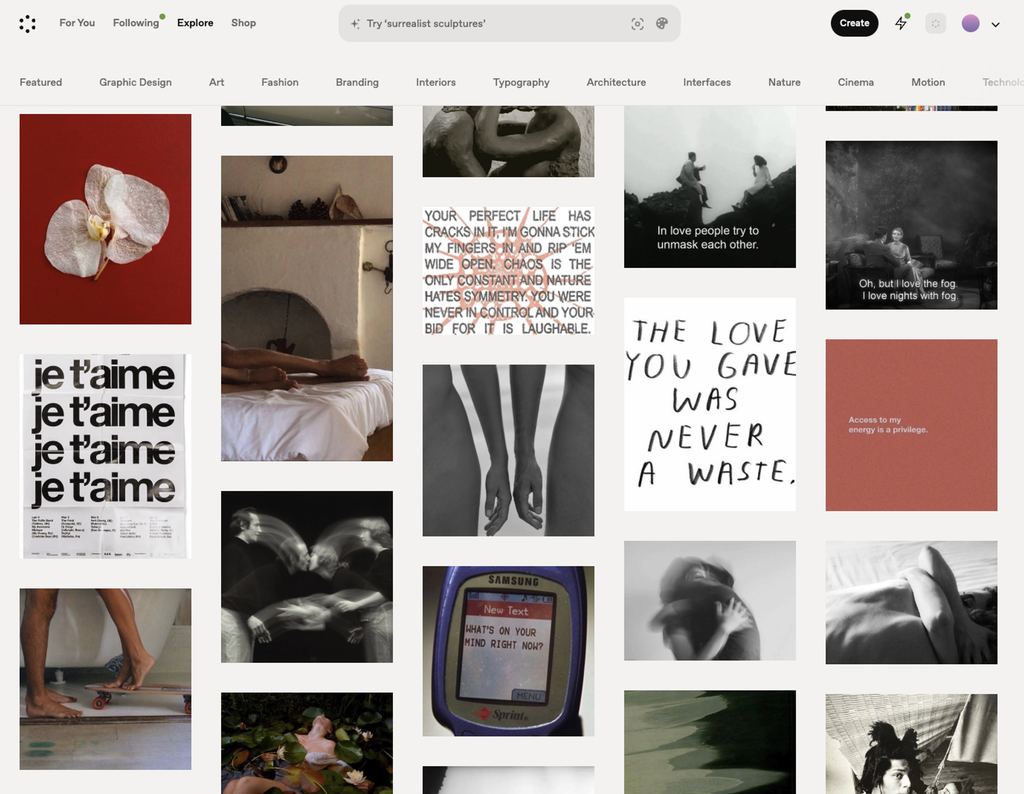
Second, a logic of expansion that no longer relies on the constant acceleration of the feed. With Cosmos, for example, the goal is no longer to maximise scrolling, but to organise a deliberately curated space. To save, organise, connect and let things mature. Here, the post-naive takes on an aesthetic and experiential form: after the era of the feed, the return of the cluster; after the instantaneity of the stream, the slower time of resonance.
The third criterion is the rehabilitation of heuristics and human recommendation in the face of an all-algorithmic culture. On Perfectly Imperfect (pi.fy), the main impulses come from an editorial team that dives into the network to surface its most interesting contributions. They suggest perspectives, put out calls for contributions and direct attention. Here, the hierarchy of visibility is no longer entirely delegated to the machine. Choice, taste and intention are brought back into the equation.
The Post-Naive as a Way to Recreate the Emotion of Luxury
The post-naive is not the end of digital desire. It is its conscious maturation. A way of continuing to seek grace in a world where no one is fooled anymore, but where everyone still hopes to be moved.
Rather than building a spectacular but hollow interface, Margiela chose to use an existing utilitarian infrastructure, Dropbox, to open up its archives. It is perhaps one of the most post-naive gestures of recent years: rather than investing in an expensive technological fiction, repurposing an ordinary tool designed for collaborative work to reveal the magic of the creative process. The effect is powerful precisely because it does not try to impress. It gives access to the intimacy of the studio, the complexity of craftsmanship and the depth of an archive.
Luxury is therefore no longer defined solely by the brilliance of the final result, but by the depth of its genesis. We move from promise to proof.
Beyond the purely digital realm, the post-naive can also become a strategy for cultural resonance. Miu Miu understands this well: in a world saturated with superficial interactions, desirability can also be built by reconstructing rarer forms of attention. Through its initiatives around reading or unconventional projects such as The Truthless Times, the House does not seek to simulate artificial social proximity. It offers something else: a community of thought, intellectual complicity, a sense of belonging grounded in strong cultural values rather than the conversational noise of platforms.
The post-naive does not, then, herald an exit from the digital world. Rather, it marks the end of a belief: the belief that more connection is enough to create more relational value. For luxury, it opens up a subtler horizon.
No longer capturing attention at any cost, but building forms of presence that people still choose to inhabit.